

Hey there! As a supplier of FRP (Fiber Reinforced Plastic) production lines, I'm super stoked to walk you through the main components of these awesome setups. FRP is a game - changer in various industries, from construction to automotive, and having a top - notch production line is key to churning out high - quality FRP products.
Resin Mixing System
Let's kick things off with the resin mixing system. This is where the magic starts. The resin is the binder that holds the fibers together in FRP. In our production lines, we've got a state - of - the - art resin mixing system. It can precisely measure and blend different types of resins, like polyester, epoxy, or vinyl ester, with additives such as catalysts, hardeners, and pigments.
The system is designed to ensure a homogeneous mixture every single time. We use advanced mixing blades and agitators that can handle high - viscosity resins without a hitch. This consistent mixture is crucial because it directly impacts the mechanical properties and appearance of the final FRP product. If the resin isn't mixed properly, you might end up with weak spots or uneven color in the FRP.
Fiber Feeding Unit
Next up is the fiber feeding unit. Fibers are the backbone of FRP, providing strength and stiffness. We offer different options for fiber feeding, depending on the type of fibers being used. Glass fibers are the most common, but we can also handle carbon fibers and aramid fibers.
The fiber feeding unit carefully unwinds the fiber rovings or mats and feeds them into the production process at a controlled speed. It's essential to maintain a steady feed rate to ensure uniform fiber distribution in the FRP. Our unit uses sensors and tension control mechanisms to make sure the fibers are fed smoothly and without any breaks. This way, we can produce FRP products with consistent strength and performance.
Molding Equipment
The molding equipment is where the FRP takes its final shape. We have a variety of molding options, including open molding, closed molding, and pultrusion.

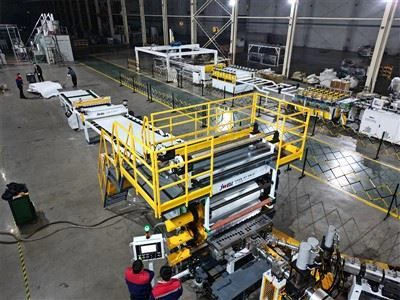
Open molding is a relatively simple and cost - effective method. It involves laying the fibers and resin on an open mold and allowing it to cure. However, it has some limitations in terms of precision and environmental control.
Closed molding, on the other hand, offers better quality and more precise control. It includes processes like resin transfer molding (RTM) and vacuum infusion. In RTM, the resin is injected into a closed mold containing the pre - placed fibers. Vacuum infusion uses a vacuum to draw the resin into the fibers, ensuring better impregnation.
Pultrusion is a continuous molding process that's great for producing FRP profiles with a constant cross - section. It's highly efficient and can produce long lengths of FRP products with consistent quality. Our pultrusion machines are equipped with advanced heating and cooling systems to ensure proper curing and dimensional stability.
Curing Oven
After the molding process, the FRP needs to be cured to achieve its full strength. That's where the curing oven comes in. Our curing ovens are designed to provide a controlled environment for the curing process. They can maintain a specific temperature and humidity level for a set period of time.
The curing time and temperature depend on the type of resin and the size of the FRP product. Our ovens are programmable, so we can set the exact parameters required for each job. This ensures that the FRP products are fully cured and have the desired mechanical properties.
Cutting and Finishing Equipment
Once the FRP is cured, it needs to be cut to the right size and finished. Our cutting equipment can handle different types of cuts, including straight cuts, bevel cuts, and curved cuts. We use high - precision saws and lasers to ensure clean and accurate cuts.
After cutting, the FRP products may need some finishing touches, such as sanding, polishing, or painting. Our finishing equipment can take care of all these tasks. We have sanding machines that can smooth out the surface of the FRP, and painting booths that can apply a durable and attractive finish.
Quality Control System
Quality control is a big deal in our FRP production lines. We have a comprehensive quality control system that monitors every step of the production process. It includes sensors and testing equipment that can detect any defects or inconsistencies in the FRP products.
For example, we use ultrasonic testing to check for internal defects in the FRP, such as voids or delaminations. We also perform mechanical testing, like tensile strength and flexural strength tests, to ensure that the products meet the required standards. Any products that don't pass the quality control tests are immediately rejected and re - worked or discarded.
Automation and Control System
To make our FRP production lines more efficient and reliable, we've incorporated an advanced automation and control system. This system can monitor and control all the components of the production line, from the resin mixing system to the cutting and finishing equipment.
It uses programmable logic controllers (PLCs) and human - machine interfaces (HMIs) to allow operators to easily set and adjust the production parameters. The system can also collect data on the production process, such as production speed, temperature, and quality control results. This data can be used to optimize the production process and improve the overall efficiency of the line.
Related Product Lines
If you're also interested in other types of extrusion lines, we've got some great options for you. Check out our PP Honeycomb Board Extrusion Line, which is perfect for producing lightweight and strong honeycomb boards. We also have an Automotive Interior TPU Over ABS Composite Panel Extrusion Line that can create high - quality composite panels for automotive interiors. And for the PV industry, our Eco - friendly Backsheet Sheet Production Machine for PV Industry is a great choice.
Conclusion
So, there you have it - the main components of an FRP production line. Each component plays a crucial role in producing high - quality FRP products. Whether you're in the construction, automotive, or any other industry that uses FRP, having a reliable production line is essential.
If you're thinking about investing in an FRP production line or have any questions about our products, don't hesitate to reach out. We're here to help you find the perfect solution for your business. Let's start a conversation and see how we can work together to take your FRP production to the next level.
References
- "Handbook of Fiber - Reinforced Plastics" by V. K. Kaw
- "Composite Materials: Design and Applications" by David A. Dillard