

Hey there! As a supplier of sheet extrusion lines, I often get asked a bunch of questions from customers. One of the most common ones is, "Can a sheet extrusion line produce sheets with anti-UV properties?" Well, let's dive right into this topic and find out.
First things first, let's understand what anti-UV properties are. UV, or ultraviolet, rays from the sun can cause a whole lot of damage to materials over time. They can make the color of the sheets fade, reduce their mechanical strength, and even lead to cracking and brittleness. So, having anti-UV properties in sheets is super important, especially for those that are going to be used outdoors, like in construction, agriculture, or automotive applications.
Now, the big question: Can our sheet extrusion lines make sheets with these awesome anti-UV properties? The answer is a resounding yes!
There are a few ways we can achieve this during the sheet extrusion process. One of the most common methods is by adding anti-UV additives to the raw materials. These additives work in different ways. Some of them absorb the UV rays and convert the energy into heat, which is then dissipated. Others act as a shield, reflecting the UV rays away from the sheet.
When it comes to choosing the right anti-UV additives, we've got you covered. We work with top - notch suppliers to source high - quality additives that are specifically formulated for different types of polymers. Whether you're using PLA, PE, or PS/PP, we can find the perfect additive for your needs.
Let's talk about the different types of sheet extrusion lines we offer and how they can produce anti-UV sheets.

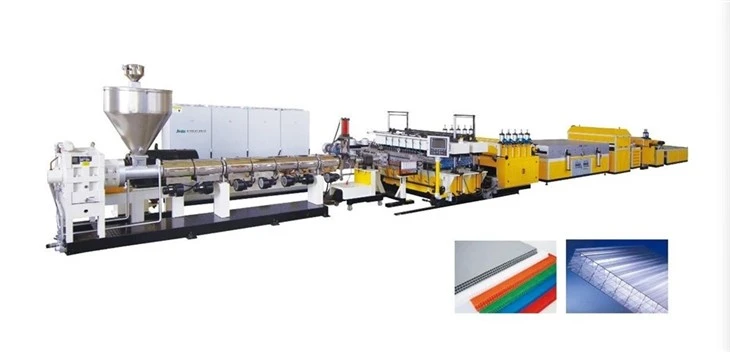
PLA Degradable Sheet Extrusion Line
The PLA Degradable Sheet Extrusion Line is a great option for those who are looking for eco - friendly solutions. PLA, or polylactic acid, is a biodegradable polymer made from renewable resources like corn starch or sugarcane. It's becoming increasingly popular in various industries, especially in packaging.
When producing PLA sheets with anti-UV properties, we carefully select the additives that are compatible with PLA. These additives need to be able to withstand the relatively low processing temperatures of PLA without degrading. Our extrusion line is designed to handle the addition of these additives smoothly, ensuring that the anti-UV properties are evenly distributed throughout the sheet.
PE Water Drainage Sheet Extrusion Line
The PE Water Drainage Sheet Extrusion Line is used to make sheets for drainage applications, usually outdoors. PE, or polyethylene, is a tough and durable polymer, but it still needs protection from UV rays, especially when used in long - term outdoor installations.
We add anti-UV agents during the extrusion of PE sheets. Our line is capable of precisely controlling the amount of additives added, so that we can achieve the desired level of UV protection. We also pay attention to the dispersion of the additives in the polymer melt. A well - dispersed additive ensures that every part of the sheet gets the same level of UV resistance, which is crucial for the long - term performance of the drainage sheets.
PS PP Sheet Extrusion Line
The PS PP Sheet Extrusion Line is used for producing sheets from polystyrene (PS) and polypropylene (PP). These polymers are widely used in packaging, trays, and other applications.
To make PS and PP sheets with anti-UV properties, we use special additive masterbatches. These masterbatches are pre - mixed with the right amount of anti-UV additives and other necessary additives. Our extrusion line can handle these masterbatches easily, mixing them homogeneously with the base polymers. This results in sheets that have consistent anti-UV performance across the entire surface.
But it's not just about adding the additives. We've also optimized our sheet extrusion lines to ensure the best possible end - product quality. Our lines are equipped with advanced controls that allow us to monitor and adjust various parameters during the extrusion process. For example, we can control the temperature, pressure, and speed of the extrusion, which all have an impact on the distribution of the anti-UV additives in the sheet.
Another important aspect is the post - extrusion treatment. Sometimes, we may use a surface coating process to further enhance the anti-UV properties of the sheets. This coating can act as an additional layer of protection, blocking more UV rays from reaching the underlying polymer.
Now, you might be wondering about the cost. Well, adding anti-UV additives does increase the cost of production to some extent. However, the long - term benefits far outweigh the additional cost. Sheets with anti-UV properties last much longer, which means less frequent replacement. This can save a significant amount of money in the long run, especially for large - scale projects.
If you're in the market for a sheet extrusion line that can produce sheets with anti-UV properties, look no further. We've got the expertise, the technology, and the products to meet your needs. Whether you're a small business just starting out or a large corporation looking to upgrade your production line, we can provide you with a customized solution.
If you have any questions or want to discuss your specific requirements, don't hesitate to reach out. We're here to help you make the best decision for your business and ensure that your sheets have top - notch anti-UV performance.
References
- Rials, T.G., & Wolcott, M.P. (eds.). (2007). Handbook of wood chemistry and wood composites. CRC press.
- Strong, A.B. (2008). Plastic materials: an introduction. Pearson Prentice Hall.