

Hey there! As a supplier of PP Sheet Extrusion Lines, I often get asked about the different components and their functions. One crucial part that plays a significant role in the process is the cooling roller. So, let's dive into what the function of the cooling roller in a PP sheet extrusion line is.
The Basics of PP Sheet Extrusion
Before we get into the details of the cooling roller, let's quickly go over how a PP sheet extrusion line works. In a nutshell, polypropylene (PP) resin is fed into an extruder. The extruder heats and melts the resin, then pushes it through a die to form a continuous sheet. This freshly formed sheet is hot and malleable, and that's where the cooling roller steps in.
Cooling Function
The primary function of the cooling roller is, well, cooling! When the PP sheet comes out of the die, it's at a very high temperature. If it's not cooled properly, the sheet will be too soft and might deform or stick to other parts of the equipment. The cooling roller rapidly reduces the temperature of the sheet, allowing it to solidify and maintain its shape.
The cooling process is carefully controlled. The temperature of the cooling roller is regulated to ensure that the sheet cools at an optimal rate. If it cools too quickly, the sheet might develop internal stresses, which can lead to warping or cracking. On the other hand, if it cools too slowly, the production speed will be affected, and the sheet might not have the desired mechanical properties.
Surface Finish Improvement
Another important function of the cooling roller is to improve the surface finish of the PP sheet. As the hot sheet comes into contact with the smooth surface of the cooling roller, it takes on the texture of the roller. This results in a smooth and glossy finish on the sheet.
The cooling roller can also be designed with different surface patterns if a specific texture is required. For example, a matte finish can be achieved by using a roller with a slightly rough surface. This is useful for applications where a non - reflective surface is needed, such as in some packaging or display products.

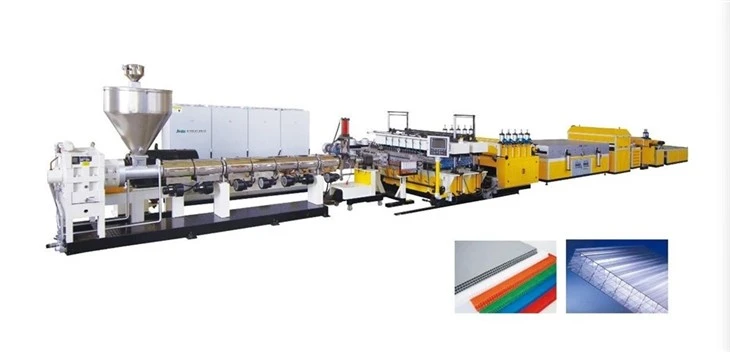
Thickness Control
The cooling roller also helps in controlling the thickness of the PP sheet. By adjusting the gap between the cooling roller and other rollers in the line, the thickness of the sheet can be precisely regulated. As the hot sheet passes through the rollers, it is squeezed to the desired thickness.
During the cooling process, the material contracts. The cooling roller's design and operation take this contraction into account to ensure that the final sheet has a uniform thickness across its width and length. This is crucial for applications where precise thickness is required, like in the production of plastic cards or some industrial components.
Tension and Flatness
Maintaining proper tension in the PP sheet is essential for its quality. The cooling roller helps in creating and controlling the tension in the sheet as it moves through the extrusion line. It ensures that the sheet moves smoothly without wrinkling or sagging.
A flat and wrinkle - free sheet is important for many applications. For instance, in the printing industry, a flat sheet is necessary for accurate printing. The cooling roller, along with other components in the line, works together to keep the sheet flat and in the correct position.
Different Types of Cooling Rollers
There are different types of cooling rollers used in PP sheet extrusion lines. Some are made of metal, such as steel or aluminum, which have good heat transfer properties. These metal rollers can be cooled by circulating water or other cooling fluids inside them.
There are also rubber - covered cooling rollers. Rubber - covered rollers can provide better grip on the sheet, which is useful for controlling the movement of the sheet through the line. They can also help in reducing the risk of scratching the surface of the sheet.
Impact on Production Efficiency
The performance of the cooling roller has a direct impact on the production efficiency of the PP sheet extrusion line. A well - designed and properly functioning cooling roller allows for higher production speeds. Since it can cool the sheet quickly and effectively, the line can produce more sheets in a given time.
On the other hand, if the cooling roller is not working correctly, it can lead to production delays. For example, if the cooling is uneven, the sheets might need to be re - processed or even discarded, which wastes time and materials.
Related Products in Our Portfolio
As a PP Sheet Extrusion Line supplier, we also offer other related products. If you're interested in different types of extrusion lines, check out our Dryer-free Vented PET Sheet Extrusion Line. It's a great option for producing PET sheets with high efficiency.
We also have the Single-layer Or Multi-layer Sheet Extrusion Machine, which can be used to create sheets with different layer structures according to your specific needs. And for those looking for a solution for producing PE water drainage sheets, our PE Water Drainage Sheet Extrusion Line is a top - notch choice.
Conclusion
In conclusion, the cooling roller is a vital component in a PP sheet extrusion line. Its functions of cooling, surface finish improvement, thickness control, tension and flatness maintenance are all crucial for producing high - quality PP sheets.
If you're in the market for a PP Sheet Extrusion Line or have any questions about the cooling roller or our other products, feel free to reach out to us. We're here to help you find the best solution for your production needs.
References
- "Plastics Extrusion Technology Handbook" by Allan A. Griff
- "Extrusion of Plastics: Theory and Practice" by John A. Brydson