

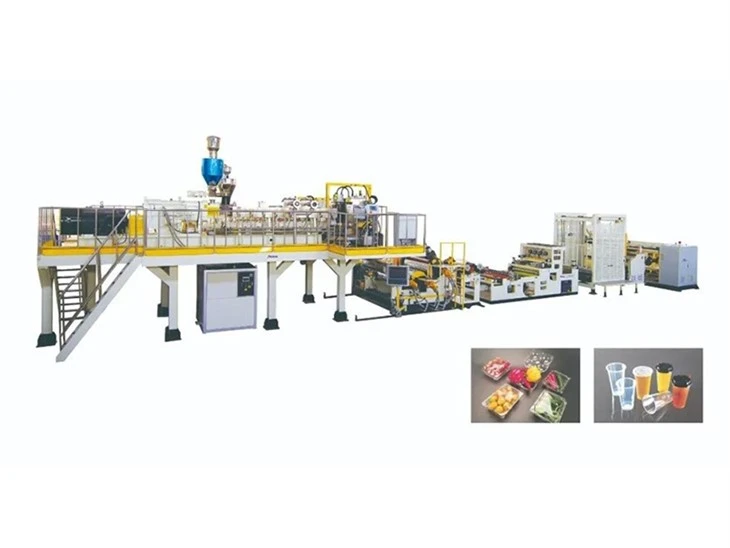
As a supplier of PET Sheet Extrusion Lines, I've been deeply involved in the production and understanding of PET sheets. Over the years, I've witnessed the evolution of quality standards in this industry, and I'm excited to share my insights on what constitutes the quality standard for PET sheets produced by an extrusion line.
1. Physical Properties
Thickness and Tolerance
One of the most fundamental quality aspects of PET sheets is their thickness. The thickness should be uniform across the entire sheet. For most industrial applications, a tight tolerance is required. Typically, the thickness tolerance for high - quality PET sheets is within ± 0.01mm for sheets thinner than 1mm and ± 0.03mm for sheets thicker than 1mm. Our extrusion lines are designed to achieve such precise thickness control. During the extrusion process, advanced sensors continuously monitor the thickness of the sheet, and the control system adjusts the extrusion parameters in real - time to maintain the desired thickness.
Surface Smoothness
A smooth surface is essential for PET sheets, especially for applications such as packaging and display. The surface roughness of PET sheets is usually measured in micrometers. High - quality PET sheets should have a surface roughness (Ra) of less than 0.1μm. Our extrusion lines are equipped with high - precision calendering units that can ensure a smooth and glossy surface finish. The calendering process involves passing the extruded sheet through a series of heated rollers, which not only smooth the surface but also improve the mechanical properties of the sheet.
Transparency
Transparency is a crucial property for many PET sheet applications, such as food packaging and optical components. The transparency of PET sheets is measured by the percentage of light transmission. High - quality PET sheets should have a light transmission rate of over 90%. Our extrusion lines use high - grade PET resin and advanced extrusion technology to ensure excellent transparency. The extrusion process is carefully controlled to minimize the formation of bubbles and impurities, which can reduce the transparency of the sheet.
2. Mechanical Properties
Tensile Strength
Tensile strength is an important mechanical property that measures the ability of a PET sheet to withstand stretching forces. For most applications, the tensile strength of PET sheets should be at least 50MPa. Our extrusion lines can produce PET sheets with a tensile strength of up to 80MPa, which is achieved through proper resin selection, extrusion process optimization, and post - extrusion treatment. During the extrusion process, the orientation of the polymer chains can be controlled to enhance the tensile strength of the sheet.
Elongation at Break
Elongation at break measures the amount of stretching a PET sheet can undergo before it breaks. A high elongation at break is desirable for applications that require flexibility, such as thermoforming. High - quality PET sheets should have an elongation at break of at least 100%. Our extrusion lines can produce PET sheets with an elongation at break of up to 300%, which is achieved through a combination of resin formulation and extrusion process control.

Impact Resistance
Impact resistance is another important mechanical property, especially for applications where the PET sheet may be subjected to sudden impacts. High - quality PET sheets should have good impact resistance, which is usually measured by the Izod impact strength. The Izod impact strength of our PET sheets can reach up to 20kJ/m², which is suitable for a wide range of applications, including automotive interior parts and electronic device housings.
3. Chemical Properties
Chemical Resistance
PET sheets are known for their good chemical resistance. They are resistant to many common chemicals, such as acids, alkalis, and organic solvents. However, the degree of chemical resistance depends on the type of resin and the processing conditions. Our PET sheets are formulated to have excellent chemical resistance, which makes them suitable for applications in the chemical and pharmaceutical industries. For example, they can be used to produce chemical storage containers and pharmaceutical packaging.
Hygroscopicity
PET is a hygroscopic polymer, which means it can absorb moisture from the environment. Excessive moisture absorption can affect the mechanical and optical properties of the PET sheet. High - quality PET sheets should have low hygroscopicity. Our extrusion lines are equipped with drying systems that can reduce the moisture content of the PET resin to less than 0.02% before extrusion. This ensures that the final PET sheets have stable properties and are less prone to deformation and degradation.
4. Environmental and Safety Standards
Recycling and Sustainability
In today's environmentally conscious world, the recyclability and sustainability of PET sheets are becoming increasingly important. PET is a highly recyclable polymer, and our extrusion lines are designed to support the production of recyclable PET sheets. We also offer PLA Degradable Sheet Extrusion Line for customers who are looking for more sustainable alternatives. PLA is a biodegradable polymer made from renewable resources, and it can be used to produce sheets with similar properties to PET.
Food Contact Safety
For applications in the food packaging industry, PET sheets must meet strict food contact safety standards. Our PET sheets are made from food - grade resin and are compliant with international food contact safety regulations, such as the FDA (Food and Drug Administration) regulations in the United States and the EU (European Union) regulations. This ensures that our PET sheets can be safely used to package food products.
5. Customization and Application - Specific Requirements
In addition to the general quality standards, different applications may have specific requirements for PET sheets. For example, the PE Water Drainage Sheet Extrusion Line is designed to produce sheets with specific drainage properties, while the Sheet Co - Extrusion Line can be used to produce multi - layer sheets with different properties. Our company has the ability to customize the extrusion process and the sheet properties according to the customer's specific requirements.
If you are interested in purchasing a PET Sheet Extrusion Line or have any questions about the quality standards of PET sheets, please feel free to contact us for further discussion and negotiation. We are committed to providing you with high - quality products and excellent service.
References
- "Plastics Extrusion Technology" by Allan A. Griff.
- "Handbook of Thermoplastics" edited by O. Olabisi.
- Industry standards and regulations related to PET sheets, such as ASTM and ISO standards.