

Hey there! As a supplier of PC Hollow Sheet Extrusion Lines, I often get asked about the screw design of these lines. It's a crucial part of the whole setup, so I thought I'd break it down for you in this blog post.
First off, let's talk about what a PC Hollow Sheet Extrusion Line is. It's a machine that's used to produce polycarbonate (PC) hollow sheets. These sheets are super versatile and are used in a bunch of different industries, like construction, advertising, and agriculture. They're known for being lightweight, strong, and having good insulation properties.
Now, the screw is like the heart of the extrusion line. It plays a key role in melting, mixing, and transporting the PC resin through the machine. The design of the screw can have a huge impact on the quality of the final product, as well as the efficiency of the production process.
There are a few important factors to consider when it comes to the screw design of a PC Hollow Sheet Extrusion Line.
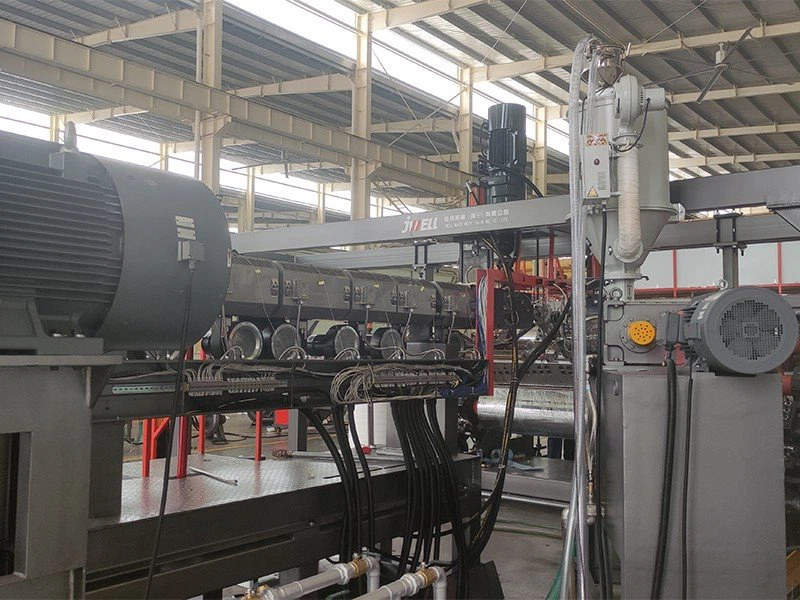

1. Screw Diameter
The screw diameter is one of the first things to think about. A larger diameter screw can generally handle more material and produce sheets at a higher output rate. But it also requires more power to operate. On the other hand, a smaller diameter screw might be more energy - efficient but will have a lower production capacity. For most standard PC Hollow Sheet Extrusion Lines, the screw diameter can range from 60mm to 120mm, depending on the specific requirements of the production.
2. Compression Ratio
The compression ratio is another critical factor. It's the ratio of the volume of the feed section to the volume of the metering section of the screw. A higher compression ratio means that the resin is compressed more tightly as it moves through the screw. This helps in better melting and mixing of the PC resin. For PC materials, a compression ratio of around 2.5:1 to 3:1 is commonly used. This range ensures that the resin is properly melted and homogenized without causing too much stress on the material, which could lead to degradation.
3. L/D Ratio (Length to Diameter Ratio)
The L/D ratio refers to the ratio of the length of the screw to its diameter. A higher L/D ratio provides more residence time for the resin in the screw, which allows for better melting and mixing. It also helps in achieving a more uniform temperature distribution along the screw. For PC Hollow Sheet Extrusion Lines, an L/D ratio of 28:1 to 36:1 is often used. This gives enough time for the PC resin to melt completely and for any additives or colorants to be evenly dispersed.
4. Flight Design
The flight design of the screw is also important. The flights are the helical ridges on the screw that help in transporting the resin. There are different types of flight designs, such as single - flight and double - flight screws. Single - flight screws are simpler and are often used for basic extrusion processes. Double - flight screws, on the other hand, can provide better mixing and conveying efficiency. They can help in reducing the residence time of the resin in the screw while still ensuring good melting and mixing.
5. Screw Material
The material of the screw is crucial for its durability and performance. Since PC resin can be quite abrasive during the extrusion process, the screw needs to be made of a high - quality, wear - resistant material. Stainless steel is a popular choice because it's corrosion - resistant and can withstand the high temperatures and pressures involved in the extrusion process. Some screws are also coated with special materials, like tungsten carbide, to further enhance their wear resistance.
How Our Screw Design Benefits You
At our company, we've spent a lot of time perfecting the screw design for our PC Hollow Sheet Extrusion Lines. Our screws are designed with the right combination of diameter, compression ratio, L/D ratio, and flight design to ensure optimal performance.
- High - Quality Output: The precise screw design allows for excellent melting and mixing of the PC resin, resulting in high - quality hollow sheets with uniform thickness and good mechanical properties.
- Energy Efficiency: We've optimized the screw design to reduce energy consumption without sacrificing production capacity. This means you can save on operating costs in the long run.
- Long - Term Durability: Our screws are made from high - quality materials and are built to last. This reduces the need for frequent replacements and maintenance, saving you both time and money.
If you're in the market for a PC Hollow Sheet Extrusion Line, you might also be interested in some of our other extrusion lines. We also offer the PMMA GPPS Plastic Endurance Board Extrusion Line, which is great for producing plastic endurance boards. And if you're looking into flooring production, our SPC Stone - plastic Environmental Floor Extrusion Line could be a perfect fit. For those interested in corrugated plates, we have the PC Corrugated Plate Extrusion Line.
We're always happy to have a chat with you about your specific requirements. Whether you're a small - scale producer or a large - scale manufacturer, we can help you find the right extrusion line for your business. If you have any questions or want to discuss a potential purchase, don't hesitate to reach out. We're here to assist you every step of the way.
References
- "Extrusion of Plastics: Theory and Practice" by John A. Brydson
- "Handbook of Plastic Extrusion Technology" by Allan A. Griff