

Hey there! As a supplier of PP Sheet Extrusion Lines, I've been getting a lot of questions lately about the tension control system in these lines. So, I thought I'd take a few minutes to break it down and explain what it does and why it's so important.
First off, let's talk about what a PP sheet extrusion line is. In simple terms, it's a machine that takes raw polypropylene (PP) resin and turns it into a continuous sheet of plastic. This process involves melting the resin, pushing it through a die to give it the desired shape, and then cooling it down to solidify the sheet.
Now, here's where the tension control system comes in. During the extrusion process, the PP sheet needs to be pulled at a consistent speed and with the right amount of tension. If the tension is too high, the sheet can stretch or even break. On the other hand, if the tension is too low, the sheet can sag or wrinkle, which can affect its quality and appearance.

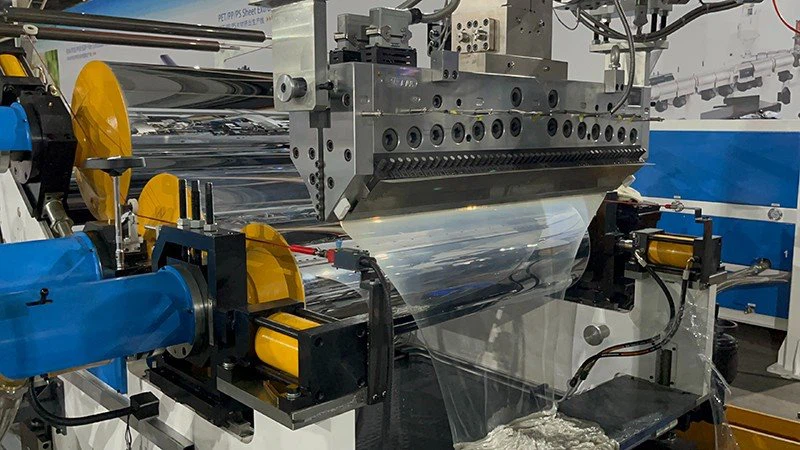
The tension control system is responsible for maintaining the optimal tension throughout the extrusion process. It does this by using a combination of sensors, motors, and controllers to monitor and adjust the speed and force of the pulling mechanism.
One of the key components of the tension control system is the tension sensor. This device measures the tension in the sheet and sends a signal to the controller. The controller then uses this information to adjust the speed of the pulling motor. For example, if the tension sensor detects that the tension is too high, the controller will slow down the motor to reduce the pulling force. Conversely, if the tension is too low, the controller will speed up the motor to increase the pulling force.
Another important part of the tension control system is the dancer roll. This is a movable roll that is used to absorb any fluctuations in the tension. As the tension in the sheet changes, the dancer roll moves up or down, which helps to keep the tension constant. The position of the dancer roll is also monitored by a sensor, which sends a signal to the controller to make any necessary adjustments.
So, why is the tension control system so important in a PP sheet extrusion line? Well, there are several reasons.
First of all, it ensures the quality of the final product. By maintaining a consistent tension, the system helps to prevent defects such as stretching, wrinkling, and sagging. This results in a smooth, uniform sheet that meets the highest quality standards.
Secondly, it improves the efficiency of the extrusion process. When the tension is properly controlled, the sheet can be pulled at a faster and more consistent speed. This means that more sheets can be produced in a shorter amount of time, which can increase productivity and reduce costs.
Finally, it extends the lifespan of the equipment. By reducing the stress on the pulling mechanism and other components, the tension control system helps to prevent wear and tear. This can save you money on maintenance and replacement parts in the long run.
In addition to these benefits, the tension control system also plays a crucial role in ensuring the safety of the operators. By preventing the sheet from breaking or getting caught in the machinery, it reduces the risk of accidents and injuries.
Now, let's take a look at some of the different types of tension control systems that are available for PP sheet extrusion lines.
One common type is the closed-loop tension control system. This system uses feedback from the tension sensor to continuously adjust the pulling force. It is highly accurate and can maintain a very precise tension, even under changing conditions.
Another type is the open-loop tension control system. This system does not use feedback from the tension sensor. Instead, it relies on pre-set parameters to control the pulling force. While it is less accurate than the closed-loop system, it is also simpler and less expensive.
There are also hybrid tension control systems that combine the features of both the closed-loop and open-loop systems. These systems offer a good balance between accuracy and cost, and are often used in applications where a high level of precision is not required.
As a supplier of PP Sheet Extrusion Lines, we offer a range of tension control systems to meet the needs of our customers. Whether you need a high-precision closed-loop system or a more cost-effective open-loop system, we can help you find the right solution for your application.
If you're interested in learning more about our HDPE T-Grip Plastic Sheet Line, PLA Degradable Sheet Extrusion Line, or PE Water Drainage Sheet Extrusion Line, please don't hesitate to contact us. We'd be happy to discuss your requirements and provide you with a customized solution.
In conclusion, the tension control system is an essential component of a PP sheet extrusion line. It plays a crucial role in ensuring the quality, efficiency, and safety of the extrusion process. By maintaining the optimal tension, it helps to produce high-quality sheets that meet the needs of our customers. If you're in the market for a PP sheet extrusion line, make sure to choose a system that includes a reliable tension control system.
References:
- Plastics Extrusion Technology Handbook, by George Gogos and James Mallouk
- Extrusion: The Definitive Processing Guide and Handbook, by Christopher Rauwendaal