


For production managers and operators in the plastic manufacturing industry, one of the most frustrating workshop disruptions is the sudden change in the pitch of a feeding machine, signaling that it is idling. You check the machine and find the hopper completely filled with material. However, despite the screw rotating at high speed, the production throughput drops to zero.
Upon closer inspection, you identify a classic case of material bridging: the raw material is suspended over the feed throat, forming a rigid arch or hollow dome that completely blocks the downward flow. While manually poking the material with a rod might offer a temporary fix, the material quickly compacts again, causing the issue to recur within minutes. Relying on manual intervention is inefficient, compromises safety, and risks introducing contaminants into your production line.
To achieve stable production and eliminate these plastic extrusion feeding problems, it is essential to understand the underlying mechanics of material flowability and implement permanent, automated extruder hopper bridging solutions. Fundamentally, bridging occurs whenever the internal friction or cohesive forces among the material particles exceed the gravitational force pulling them downward.
Root Causes: Why Do Materials Bridge in the Hopper?
Before you can fix extruder bridging, you must identify why your specific material matrix is failing to flow smoothly. Generally, material stagnation is driven by four primary factors:
1. High Material Cohesiveness and Thermal Softening
Many specialized compounds or formulations containing high concentrations of additives-such as plasticizers and lubricants-possess inherent tackiness. This issue is severely exacerbated by high ambient workshop temperatures or heat migration from the extruder barrel. When heat travels upward, the material at the bottom of the hopper softens prematurely and agglomerates under pressure, forming a solid mass that plugs the inlet.

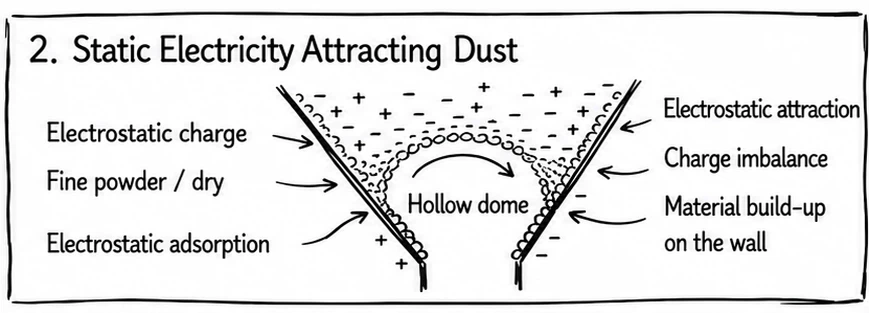
2. Electrostatic Accumulation in Fine Materials
When processing fine powder materials, micronized additives, or highly dry regrind, the continuous friction between particles generates significant static electricity. These electrostatic charges cause particles to simultaneously repel one another and adhere aggressively to the hopper walls. Over time, this material accumulation thickens along the inner circumference, culminating in a stable, interlocking hollow dome.
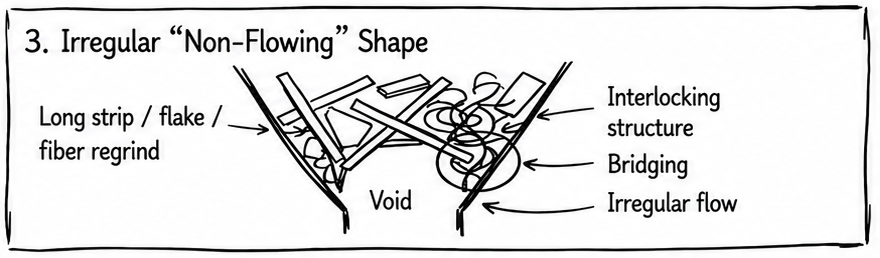
3. Irregular Particle Morphology
Standard, uniform virgin pellets flow predictably via gravity. However, the processing of post-industrial or post-consumer regrind-particularly long strips, irregular flakes, or high-fiber scrap-presents severe material handling challenges. These non-uniform shapes mechanically interlock and mesh together inside the hopper, creating a structural framework that leaves a completely empty cavity directly beneath it.
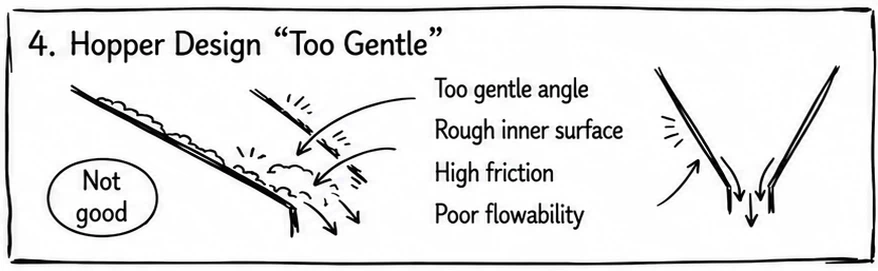
4. Suboptimal Hopper Geometry and Surface Finish
The physical design of the feeding system plays a critical role. If a hopper's inclination angle is too shallow, or if its inner walls have a rough surface finish, the coefficient of friction increases dramatically. This high frictional resistance restricts smooth gravity flow, meaning even minor variations in material bulk density can halt the downward movement entirely.
Engineered Extruder Hopper Bridging Solutions
Resolving these plastic extrusion feeding problems requires shifting away from reactive manual troubleshooting toward proactive, engineered flow aids. Below are the industry-standard methods utilized to ensure uninterrupted material delivery.
|
Method |
Mechanism |
Best Suited For |
Key Operational Considerations |
|
Feed Throat Cooling |
Prevents premature thermal softening via a water jacket. |
Sticky compounds, high-additive resins, high-temperature environments. |
Maintain a consistent, regulated flow of cooling water. |
|
Mechanical Agitation |
Low-speed paddles actively break up interlocking particle chains. |
Irregular regrind, fiber-rich materials, flakes. |
Most reliable mechanical solution; ensures constant material movement. |
|
Vibratory Flow Aids |
Uses industrial vibratory motors to eliminate wall friction |
Non-sticky, larger particulate materials. |
Caution: Can over-compact fine powders if operated continuously. |
|
Surface Engineering |
Reduces wall friction via mirror polishing or PTFE/Teflon coatings |
Fine powders, cohesive materials, sticky formulations. |
Provides a passive, low-maintenance solution for smooth mass flow.. |
|
Pneumatic Fluidization |
Injects bursts of dry compressed air via air disks or nozzles. |
Fine powders, highly electrostatic materials. |
Requires strictly dried, oil-free compressed air to prevent moisture contamination. |

Critical Operational Details to Optimize Material Flow
In addition to implementing mechanical or thermal hardware upgrades to fix extruder bridging, several subtle process parameters must be tightly controlled to maintain process equilibrium:
Rigorous Moisture Management: Material that has absorbed ambient moisture acts as a natural binding agent, drastically increasing cohesion between particles. Implementing thorough pre-drying protocols eliminates this water-induced stickiness, solving many feeding issues at the source.
Optimizing Powder-to-Pellet Ratios: When running custom blends, carefully regulate the percentage of fines or powder components. An excessive concentration of powder increases the risk of hopper bridging and can cause severe screw slippage inside the feeding zone.
Geometric Modification of the Discharge Opening: If retrofitting flow aids is restricted by space, modifying the physical dimensions of the feed throat can yield immediate results. Slightly increasing the diameter of the lower discharge opening, or transitioning the geometry from a traditional round design to a square configuration, alters the stress distribution of the material and effectively prevents arching.
By systematically evaluating your material characteristics and combining proper thermal management at the feed throat with mechanical or pneumatic flow aids, you can effectively eliminate downtime, protect your processing equipment, and ensure a highly stable, continuous extrusion output.